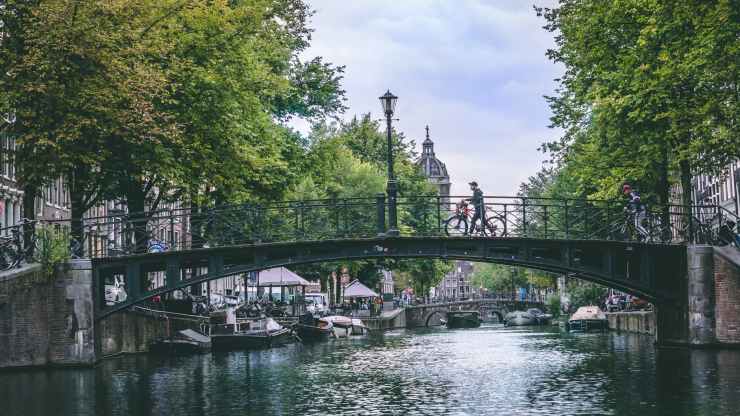
From my MBA at the Universidad de Europa Madrid in Valencia 2011 to 2012 when we spent a week long course on working in Multicultural teams at the Hogeschool van Amsterdam University of Applied Sciences.
Intercultural Communications Management Seminar: Environment
This report will investigate and analyse how the management of 3 different multinational organisations approaches cultural issues in regards to how the environment affects how they operate in Amsterdam.
For this report the following definitions are used: Environment; the physical structure of the place of work, the layout of the work spaces (open plan or individual offices), lighting conditions (natural or artificial light), onsite catering facilities, access to transportation infrastructure and all physical factors that enable or hinder how the employees work. Culture; the behaviours and beliefs that are characteristic of a particular nation, corporation (subsidiary, national, and regional), individual or an international organisation.
The companies that were investigated were RIPE NCC, Heineken and Vodafone Netherlands. RIPE NCC is an independent non-profit organization that supports the structure of the internet. It provides IP addresses (IPv4 and IPv6), IT training, information services and support to its members. It was founded in 1992 and currently has 8,000 members mainly Internet Service Providers (ISPs), telecommunication organizations and large corporations located in in 76 countries from Europe, the Middle East and parts of Central Asia. RIPE NCC is considered an open, transparent and self-governing organization, this is demonstrated in the way its policies and procedures that govern how the organization operates are proposed, discussed and accepted by its members. RIPE NCC activities are the development and maintenance of the RIPE database, administrative support for the RIPE community and outreach activities with governments and industry-related organizations.
Heineken International (owned by Heineken Holding N.V.) is the 3rd largest beer company in the World and was founded in Amsterdam in 1864 and describes itself as a global company with Dutch heritage. Globally it has 70,000 in 71 countries with 140 breweries with 200 local and international beer and cider brands that are sold in 172 countries, with two of the main global brands being Heineken and Amstel. The Head Quarters is in Amsterdam and the World is divided into 5 operating regions (Europe, The Americas, Africa, the Middle East and Asia – Pacific) each with its own Regional President who along the Executive Board and the 6 Chief Officers forms the Executive Committee that manages Heineken. The values of Heineken are; Enjoyment – for their clients through responsible consumption and to staff, Respect – for individuals, society and the environment, local and international laws (no child labour) are followed and local cultures are respected and finally Passion – they have a passion for quality in its products, the Heineken beer has maintained the same taste and high level of quality since it was created 150 years ago, its staff and technology. Heineken is centrally managed though strict corporate policies and codes of practices for the whole company and their suppliers, so to make sure everyone follows the company values and protects the brands.
Vodafone was founded in 1985 by the Racal Electronics Group and was the UK’s first cellular network. Now it has 371 million customers 30 countries and has partner networks in another 40+ and is classed as the 7th most valuable brand in the world. It has a history of technological innovation through pioneering the use of the mobile phone for international roaming (world’s first roaming call in 1991), voice mail, information lines, instant messaging, WAP (Vodafone Live 2002), mobile internet (3G and 4G) and to use a mobile to pay for goods, services and to transfer money. As a global company it produces its own handsets for its markets including low cost handsets (Vodafone 150) for emerging markets, so to promote mobile phone use in developing countries. It is aware of its impact on the world and in 2002 it launched the Vodafone Group Foundation to fund social initiatives around the world. Its motto for its clients and employees is “power to you” and it wants to empower its employees and clients achieve what they desire.
The cultures that this report is investigating is the national culture of the Netherlands, where these companies or subsidiaries are based, the individual culture of the employees (Amsterdam is an international city where 40% of the city is classed as non-Dutch (the Dutch government define Dutch as having 2 Dutch parents, if only one parent is Dutch then you are classed as non-Dutch), the corporate culture (industry, sector, profession and department) and the international culture created by these multinational organisations.
The cultural theories of Chaney, Hofstede, Anderson and Earley will be used to analyse the cultures of the individuals, the Netherlands, the corporate and the international cultures and how culture affects their view of time and task orientation.
The culture of the Netherlands is divided into two clear distinct parts, the north and the south, which are divided by the rivers of the Rhine, Maas and Waal. The north is known as “contract country” because the Dutch there are very direct and start talking about business as soon as you meet them, as well as being more cold and unfriendly; therefore they are more culturally aligned to Germany and Scandinavia. While the south is known as being more open and friendly and requires the establishment of a relationship before business can be discussed, they also have a more relaxed approach to how time is viewed; more aligned to Belgium. The Netherlands is classified by Claire B Anderson as being a low context country, therefore they prefer direct communication that focuses on what has to be done and they are not interested in lots of background information, the facts are more important. Based on Chaney’s analysis on a cultures approach to time the Dutch are monochromic, therefore they are task orientated (only one task at a time) and plan in detail how they use their time. According to Hofstede the Dutch are a very equal society (Power Distance Index of 38) where everyone can speak to anyone, there is open communication, everyone can have their say, for instance they do not wait for their boss to talk first in a meeting before contributing. They are very independent (Individualism of 80) and strongly believe in personal responsibility and are more focused on quality of life than (MAS of 14, a feminine society) than focusing on being number 1 and earning a lot of money or gaining status for themselves as an individual. They are willing to take decisions and risks without knowing a large amount of information (Uncertainty Index of 53) and have a long term view (Long Term Orientation of 44) and this is evident in their construction of flood defences.
It is common for organisations and corporations in the Netherlands to employee staff from other countries. As it is a free, open culture and collaborative culture which welcomes a high percentage of foreigners (40% of Amsterdam is Non-Dutch) and companies, especially multinationals, offer cultural training for all employees and support to the expats who are moving to live and work in the Netherlands. Multinationals have their own culture that is based on the culture where the company was founded and then this culture is then exported to the rest of the group, while taking into account local sensitivities, with the aim of creating a clear corporate identity for its staff and clients.
With such a multicultural environment it is clear that the Cultural Intelligence (CQ), as outlined by Earley (2003), of employees of multinational organisations is vitally important to the success of the organisation. CQ is not only required by the expats to work aboard but by the all employees so they are able to work with colleagues from other cultures and countries.
The investigation will be performed through an onsite visit to the offices of the 3 companies where the cultures of the work place and how they are affected by the environment will be observed and an interview will be performed with a company representative.
What was looked for during the visit?
- State of the desks (clean desk policy or could employees decorate their work space).
- What were on the walls (work information, personal photos, displays etc.).
- State of the shared areas (kitchen, reception, corridors) in regards to what was on display and what message was being broadcast (friendly atmosphere, employee centred and promotion of the company).
- Building design.
- Office layout (open plan, individual offices) how does this communicate the office culture (individual offices – hierarchy, open plan – open culture, shared spaces for working in teams.
- Lighting (natural or artificial light).
- Transportation (access to public transport, company support of public transport or green transportation).
- Dress code of the employees (formal, business casual, casual).
See Appendix for results of the company visits
From the results it is evident that the cultural theory about the Netherlands is true, it is a very open, equal and tolerant society. In a slight contradiction to Hofstede who states that it is a very feminine society that believes in collaboration and not focusing on being number 1, both Heineken and Vodafone have bonus schemes that reward staff for individual performance. This style of performance management is very masculine, according to Hofstede dimensions, and would be more expected of a company in the USA or the UK rather than the Netherlands.
In conclusion, it is important to take into account several factors that influence the performance of multicultural teams in the achievement of objectives. For instance, multicultural teams bring a lot of benefits through the knowledge of different markets and clients. However there are also challenges, as it is vital to understand different cultures (individuals, teams, departments, companies, countries) in the way they approach the achievement of tasks and view time. The fact of working in multicultural enriches the company as it offers different world views and styles for achieving objectives. Based on the investigation it is evident that the 3 multinational companies who have a multicultural work force are able to thrive in the open, tolerant and equal culture that exists in the Netherlands as long as they are aware of the cultural difference that exist and work at understanding how best to work with each other.
Appendix
| Company | RIPE NCC | Heineken | Vodafone Netherlands |
| Number of Employees | 138 | Globally 70,000 in 71 countries with 140 breweries, 200 local and international beer and cider brands | 2000 |
| Number of different Nationalities | 29 | 71+ and products are sold in 172 countries | 10+ |
| Company Structure | Flat – company sets goals but each team manages their own objectives | Hierarchical. World is divided into 5 operating regions each with its own President who reports to HQ. Central Business services (IT, Finance, equipment) and global sourcing – leverage economies of scale and have the same equipment everywhere. Heineken Brand is centrally managed for whole world. Local brands are locally managed | Part of Vodafone Group. Organised into departments and teams all reporting to the CEO. Departments and teams are spread over the Netherlands (Maastritch – finance, customer call centre, technical services. Amsterdam HQ – Business Services, Consumer Services, Corporate Management (legal, Strategy CoSec) |
| Dress code | Casual (very) | Smart (suits) | Casual (informal – no one wears a suit) |
| Individual space | Desks are personalised, employees put their mark on their work area (photos, maps). Clean desk policy was tried but rejected by the culture of individualism of the staff plus work information (project plans, objectives) | Little personal decoration of work areas | No one has a fixed desk, whole building is based on hot desk model. Everyone has a laptop and mobile, so they can walk anywhere they feel they will be the most productive. |
| Building | Historic building in the centre of Amsterdam, lots of small offices – constrains communication, lots of nature light through large windows | Historic building front but the inside is a modern office building with neutral and professional decoration. Internal walls made of glass walls allowing in lots of natural light from the many windows and shows the transparent culture of the company. | Modern office building that was especially built in 2008 and the 5 floors of Vodafone were designed for Vodafone with input from employees. Lifts are placed to one side of the building so to encourage the use of stairs. Health of the employees is very important. |
| Office layout | Rooms for individual teams and managers. Office layout is constrained by the building design (old protected building, limited changes can be made) | Glass walls, open plan with offices. Corporate posters on the wall (whistle blowing policy). In one building in Amsterdam the ground floor office is for Hot desking. Heineken offices are similar around the world, you know when you are in a Heineken office. | Offices are all open spaces with individual rooms for meetings (Video Conferencing, stand up or sit down), quiet working areas. Amazing views over Amsterdam from top floor, the office is designed so people want to be there and have freedom to work wherever they want to in the office. Mobile working is key. |
| Are the teams in the same place? | Permanent teams are in the same office, temporary teams are scattered around | Teams are around the world, but the Heineken brand is centrally managed from Amsterdam between 3 buildings within the city | There are no set areas for teams but naturally staff group themselves together by departments and teams |
| Team communication | All in the same place, so face to face | Email, phone, video conferencing, face to face (visits to other offices, HQ staff have visited every Heineken office in the world) | Through in person meetings or technology (instant messaging, email, Video Conferencing, phone, email) |
| Catering Facilities | Shared kitchen + free coffee and tea + free meal cooked by the cleaning ladies for the whole company once a week | Free bar in each building. Catering machines around the office. | Restaurant on the top floor where staff are trusted to pay for their own food (trust is evident throughout the office and company) without supervision. Vending machines on each floor. Only healthy food is available. |
| Transportation | Company pays for public transport pass. Company uses Dutch gov. scheme of allowing employees to buy a bike tax free. Secure bike storage in the basement | Car park for people who live far away, use Dutch gov. bike scheme. Have a transportation allowance for public transport. Shuttle buses between Amsterdam and Rotterdam (start earlier than public transport), Lease cars for sales and other staff depending on seniority | Choose to base office near public transport (group value), strongly encourages the use of public transport and pays the cost depending on the distance staff has to travel, bike storage under the building, only sales staff have company cars, not even the board has their own cars |
| CO2 footprint and what do you do to reduce your environmental impact (recycle) | Unknown | Very environmentally aware, want to be the “greeniest brewery in the world”. Sustainability and green policies to reduce energy use of Heineken fridges (use 10-15% less energy) and beer taps (ice cold draught beer). Waste water is treated in all breweries. Centrally managed and audited environment policies for whole world. Green distribution – use boats not trucks when possible. | Very environmentally aware with a Corporate Social Responsibility team and policies. Paperless office – discourages printing. Through encouraging staff to use public transport and reducing the amount printed they’ve reduced their CO2 emissions by 25%. Educate customers about how eco-friendly the mobiles Vodafone sells in its shops. Contributes to improving fresh water access around the world with funded projects in Bangladesh |
| Cultural training | Had it once but has not been repeated but it would be a popular idea | Expats who are transferred to a new country have extensive support and training so they and their family can settle into the new country. HQ also has training in how to work with other cultures as most of the employees are not Dutch. | No formal cultural training, but the help people from aboard settle in |
| Conclusion | Open and free culture that encourages creativity and individual freedom to achieve company objectives | Every year they survey all their staff to find out what they think of their work environment and company. Transparent environment (whistle blowing policy), demonstrated through glass walls. Local management but centrally managed polices. Aware of their impact on the world and how this affects their brands | Structure and layout of the building fits with the corporate culture of trust, self-empowerment, tolerance, open mindedness. |
 Successful International Project Management